

Daniel Hahn on 'If this be Magic - The Unlikely Art of Shakespeare in Translation'

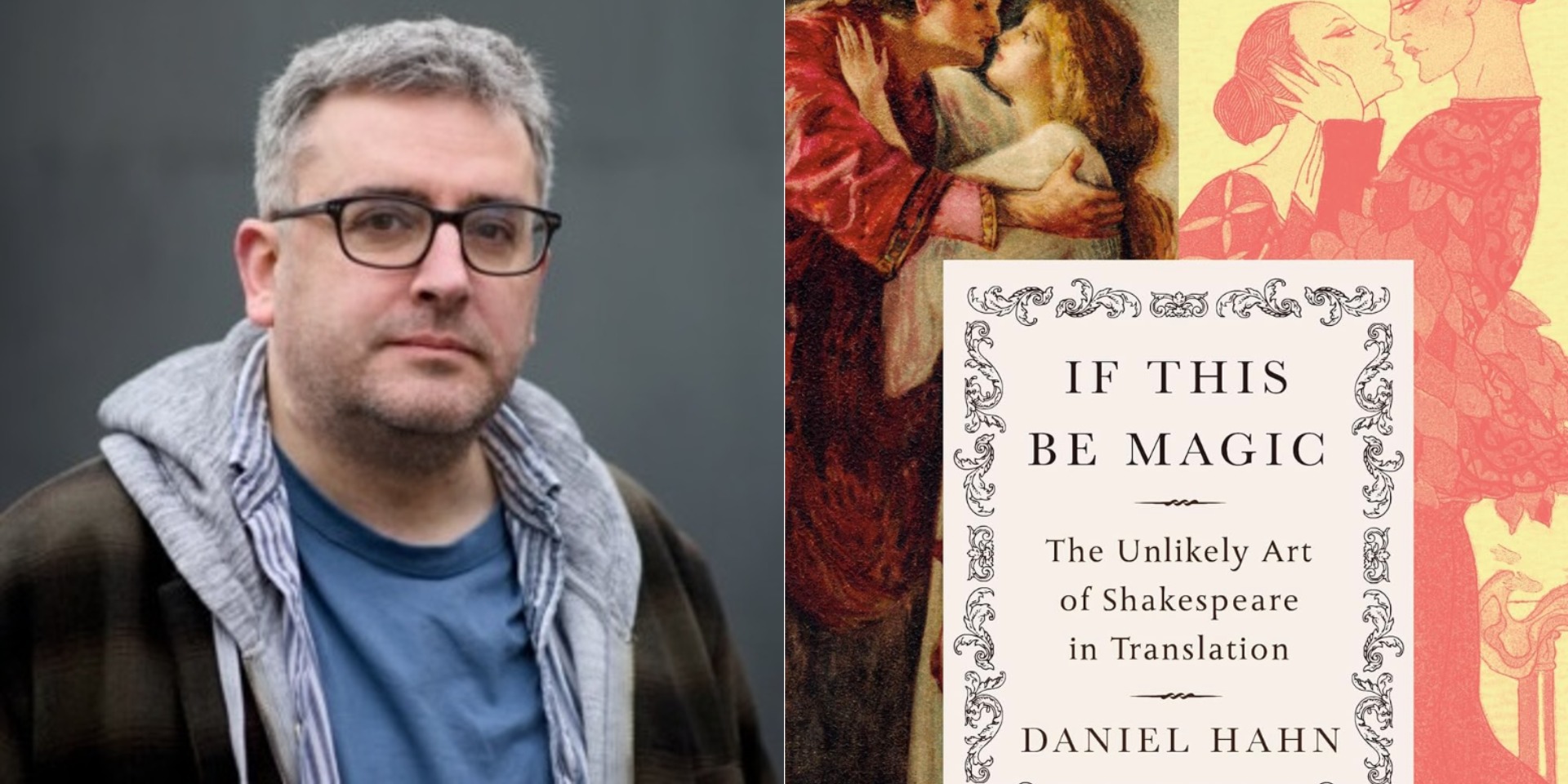
Daniel's new book, If This Be Magic: The Unlikely Art of Shakespeare in Translation, is part love letter, part close reading, and part globe-trotting investigation — one that took him from Budapest theatre seats to Zoom calls with translators working in everything from Swahili to Bangla. It's a book that asks: when you change everything, can you still keep everything?
published in April 2026 - If This Be Magic: The Unlikely Art of Shakespeare in Translation by Daniel Hahn is a non-fiction book exploring how Shakespeare's plays are translated, adapted, and re-imagined for global audiences. It investigates the challenges of translating Shakespearean language, wordplay, and poetry across different cultures and languages.


Key Takeaways
- Discover the complexities of translating Shakespeare's verse, capturing not just meaning but also the rhythm and heartbeat of his language.
- Explore the global journey of Shakespearean adaptations, from Budapest theatre seats to translators working in Swahili and Bangla.
- Understand the core question of translation: when you change everything, can you still keep everything?
- Learn about Daniel Hahn's extensive career, recognized with prestigious awards and an OBE for his contributions to literature.
- Gain insight into the 'unlikely art' of translating Shakespeare, a fascinating blend of love, analysis, and investigation.
What does it take to carry Shakespeare across languages — not just his plots and his characters, but the very heartbeat of his verse? Today I'm speaking with Daniel Hahn, one of the most celebrated literary translators working today.
With several works to his credit, he has translated fiction, nonfiction, children's books, and plays from across Europe, Africa, and the Americas. He is the recipient of the Independent Foreign Fiction Prize, the International Dublin Literary Award, the Blue Peter Book Award, and the 2023 Ottaway Award for the Promotion of International Literature. In 2020, he was appointed an OBE for his services to literature.
Daniel's new book, If This Be Magic: The Unlikely Art of Shakespeare in Translation, is part love letter, part close reading, and part globe-trotting investigation — one that took him from Budapest theatre seats to Zoom calls with translators working in everything from Swahili to Bangla. It's a book that asks: when you change everything, can you still keep everything?
published in April 2026 - If This Be Magic: The Unlikely Art of Shakespeare in Translation by Daniel Hahn is a non-fiction book exploring how Shakespeare's plays are translated, adapted, and re-imagined for global audiences. It investigates the challenges of translating Shakespearean language, wordplay, and poetry across different cultures and languages.
If you enjoy Harshaneeyam Podcast please follow the show on Apple, Spotify, or your favourite podcasting platform and leave a review for us. It will help truly help us; and don't forget to Share our podcast link with your other friends who enjoy similar content.
To help us provide even more value, using the link given below in the show notes to complete our brief Listener Survey. Your feedback is the secret ingredient that helps us improve and create content tailored to your interests!
https://www.harshaneeyam.com/survey/Listener/
* Please complete Harshaneeyam Listener Survey using the above link.
It would be lovely to have your feedback.
***Disclaimer: The views and opinions expressed by Interviewees in interviews conducted by Harshaneeyam Podcast are those of the Interviewees and do not necessarily reflect the official policy or position of Harshaneeyam Podcast. Any content provided by Interviewees is of their opinion and is not intended to malign any religion, ethnic group, club, organization, company, individual, or anyone or anything.
This podcast uses the following third-party services for analysis:
Podtrac - https://analytics.podtrac.com/privacy-policy-gdrp
Frequently Asked Questions
What is Daniel Hahn's new book about?
Daniel Hahn's new book, 'If This Be Magic - The Unlikely Art of Shakespeare in Translation,' explores the challenges and artistry involved in translating Shakespeare's plays for global audiences.
Who is Daniel Hahn?
Daniel Hahn is a celebrated literary translator known for his work across fiction, nonfiction, children's books, and plays, with numerous awards and an OBE for his services to literature.
What challenges does translating Shakespeare involve?
Translating Shakespeare involves overcoming linguistic barriers, cultural differences, and the difficulty of preserving his unique wordplay, poetry, and verse across various languages.
Where did Daniel Hahn research for his book?
His research for 'If This Be Magic' spanned various locations, including theatre seats in Budapest and virtual collaborations with translators worldwide via Zoom.
H (0:07): What does it take to carry Shakespeare across languages? Not just his plots and his characters, but the very heartbeat of his verse. Today I am speaking with Daniel Hahn, one of the most celebrated literary translators working today. With an extensive body of work to his credit, he has translated fiction, nonfiction, children's books, and plays from across Europe, Africa, and the Americas. He is the recipient of the Independent Foreign Fiction Prize, the International Dublin Literary Award, the Blue Peter Book Award, and the 2023 Out of Way Award for the Promotion of International Literature.
In 2020, he was appointed an OBE for his services to literature. Daniel's new book, If This Be Magic: The Unlikely Art of Shakespeare in Translation, is part love letter, part close reading, and part globetrotting investigation — one that took him from Budapest theatre seats to Zoom calls with translators working in everything from Swahili to Bangla. It's a book that asks: when you change everything, can you still keep everything? Published in April 2026, it is a nonfiction work exploring how Shakespeare's plays are translated, adapted, and reimagined for global audiences, and investigates the challenges of rendering Shakespearean language, wordplay, and poetry across different cultures and languages.
H (1:37): It's almost three years since I read your Catching Fire: A Translation Diary, which would be my top recommendation to anyone asking what translation really entails. So, from Catching Fire to Shakespeare — what does this new book add to the discourse on translation?
Daniel Hahn (1:57): Thank you, first of all, for the question, and for reading Catching Fire and saying such nice things about it. The Shakespeare book is similar to Catching Fire in one sense: I don't think either is full of what you might call original additions to the discourse. Neither presents a new theory of translation. But I think both are attempts to bring new people into the conversation. They're ways of doing what I'm most interested in — figuring out how to talk about translation to people who might not be experts. Neither book is written for an academic audience.
I tried very hard not to make assumptions about what my readers will know. In that sense, the books are similar. The Shakespeare book is also about Shakespeare, of course, as well as about translation. But I think it's partly about talking with genuine enthusiasm to people who may not have spent much time on these subjects, or who might not think these subjects are for them. I haven't got a new theory to sell. I'm simply trying to share things that matter to me a little more widely. That's all.
H (3:28): Unlike the authors whose books you translate, you were communicating with living translators here. You mention in the book that you had extensive conversations with most of them. What was that experience like?
Daniel Hahn (3:44): Oh, it was amazing. I decided early on that I wanted the book to be about the practicalities of translating Shakespeare, so it was obvious that I needed to track down people who had translated — or were translating — Shakespeare and actually talk to them. I ended up conducting quite extensive interviews, sometimes multiple rounds, with around 13 or 14 translators working across languages: Hungarian, Danish, Swahili, Tswana, Māori, Bangla — a real mix from many different places. A lot of the insights in the book came directly from those conversations.
What would typically happen is I'd have a one- or one-and-a-half-hour meeting on Zoom or in person, sometimes two meetings, and then I'd send them 10,000 follow-up emails: Oh, I just noticed this here — can you explain what's happened? They were all incredibly patient. But I think one of the things that became clear to me right at the very end — literally when I had my first finished copies and was sending them to the people I'd interviewed — was that the book had become a kind of fan letter. I sent a copy to the Danish translator and said, "This is basically a 400-page fan letter to you." It really is about how extraordinarily clever these people are, and their generosity allowed me to see that. Ultimately, it's about these individuals doing remarkable work, far more than it's about anything abstract.
H (5:42): I was just wondering — literary translators are normally paid by the word. So how many hours must it have taken you to complete this book? It's amazingly detailed.
Daniel Hahn (5:57): I'm not going to calculate that, because it will make me very unhappy. I will say the writing itself went quite quickly — I write fairly fast. The research took a long time, but it was also so much fun. Going to Budapest, seeing a production of Shakespeare in Hungarian — Twelfth Night, in that case — and then having lunch with the translator and talking through all the challenges and clever solutions he'd found. It was a lot of hours, and I spent a great deal of time poring over editions, trying to work out what was happening in a particular Gujarati line or an Italian one. But it was genuinely enjoyable. I don't begrudge a single hour.
H (6:55): When it comes to translating Shakespeare beyond the plot, what are the specific, smallest units of writing you believe a translator must preserve to keep Shakespeare as Shakespeare?
Daniel Hahn (7:09): That question is, in a sense, the most important question about literary translation itself. When you're translating a writer like Shakespeare — and I do argue he's a very good writer, which is not an unusual position — one of the key things is that nothing is accidental. If a line is slightly longer or shorter, if it has a cluster of consonants, if it's only a half-line, if the rhythm is interrupted — these things have an effect. So when translating Shakespeare, or any writer whose work is highly kinetic, you want to keep everything. And keeping everything requires keeping all the properties of the writing, which poses two challenges: every language works differently, and you have to notice everything in the first place.
One example I give in the book is a moment in Hamlet where Shakespeare reverses the stress at the start of a line to give a sudden jolt of impact — both to the actor speaking it and to the audience hearing it. The Danish translator has to find a way to replicate that jolt. But before doing that, they have to notice it — amid all 25,000 words of that play, across 37 or 38 plays, they must notice that "Angels and ministers of grace defend us" begins with a hard stress rather than a soft one.
So the slightly flippant answer is: everything. You need to preserve everything to keep Shakespeare as Shakespeare. But as all translators know, keeping everything also means changing everything.
H (9:25): All languages don't work the same way, of course. When a translator moves into a syllable-timed language like French or Mandarin, is it possible to replicate the same propulsive energy, or must they invent an entirely new engine?
Daniel Hahn (9:43): You have to do something, but you can't do the same thing in French as you do in English, because French doesn't operate on the system of stress we associate with iambs and trochees. French is, as you say, syllable-timed rather than stress-timed. So what you have to do as a translator is figure out what effect a given pattern is creating — whether that's regularity, or the breaking of regularity — and then use whatever tools the target language offers to replicate it.
One reason Shakespeare might use regular iambic pentameter for several lines is so that you notice when a jolt interrupts it. You establish a pattern in order to break it. When I spoke with the French translator Jean-Michel Dupuis, he described how, for Macbeth's witches — who speak in a completely different meter in English — he couldn't replicate the meter, but he could shorten the lines. So all the witches' lines have seven syllables while everything else runs longer. You think about what the function of the verse is — to create a structure from which you deviate — and then you use what you have to hand. In English, that happens to be iambs. In French, you do something different, but you build something that achieves the same effect, even if you're using entirely different materials.
H (11:40): The next question is a fascinating one. In chapter three, you highlight the moment Romeo and Juliet first speak and — apparently by accident — form a perfect sonnet. How does a translator handle a moment where the form of the poetry is itself the primary way the audience understands the characters' connection? I found that section genuinely wonderful.
Daniel Hahn (12:04): For anyone who might be intimidated by the book, this gives you a good sense of what it's like — it really is about the mechanics of language, in quite close detail. As you say, there's a moment where Romeo and Juliet have their first conversation. Romeo has been going on about Rosaline — a girl we'll never meet, who doesn't matter — and then suddenly he and Juliet are in a room together. And their first exchange, I'd say happens to form a perfect sonnet — though I'll come back to that word "happens."
They build on each other's extended metaphor. Their lines rhyme with each other's. Their first 14 lines together form a completely regular sonnet. The important thing for a translator is not only to notice that, but to assume — as we do with great writers — that it is not accidental. This is deliberate. And there is a message embedded in it: in this chaotic Verona, Romeo and Juliet are meant to be together. The moment they meet, they simply slot into perfect alignment.
The audience doesn't sit there thinking, wait, I believe lines one and three rhyme — but they hear something clicking into place with a deep satisfying precision, and they know these two people belong together. Which means, for a translator, the sonnet form isn't a cosmetic detail. It's integral to the moment. You may not be able to do a sonnet, but you want to do something — you want their lines to interlock.
And this speaks to a broader principle: form is never accidental in a writer like Shakespeare, never separate from character or content. If two characters are speaking in alternating lines of verse and one suddenly has a half-line that's completed by the other, or a half-line that's left hanging — that's meaningful. It has an effect on how the audience hears the scene. Form matters enormously, but only because it is inseparable from everything else you're translating.
H (15:16): What the writer wants to communicate — yes. It's a wonderful choice to focus on Shakespeare. He's universally known, and there's an enormous body of criticism and scholarship around him already. Presumably that existing literature helps modern translators notice precisely the kinds of shifts and nuances you're describing.
Daniel Hahn (15:50): Absolutely. There's a little discussion of this in the book. Translators working today mostly work from contemporary editions with footnotes, introductions, and critical apparatus, and they can draw on all of that, plus the internet. There's an enormous amount of accumulated knowledge they can build on. I was always astonished looking at older translations — a 1930s Brazilian translation, for instance — and thinking, how did the translator know this? He didn't have Google. The word he was working with was no longer in dictionaries. One Brazilian translator in particular that I became rather attached to — I had some issues with his translation, but I kept thinking: it is remarkable that you knew what this reference meant. I have no idea how he figured it out.
H (16:54): This follows on from that. You mention that in languages like Japanese, rhyme can feel overemphatic or unnatural. So how do translators like Kawai use the absence of rhyme to signal a shift in a character's mental state?
Daniel Hahn (17:12): It relates to what I said about meter — you sometimes create a pattern in order to break it. Rhyme does many things, but one of its functions is to establish a pattern that you then notice when it stops.
The translator you're referring to, Shoichiro Kawai, found that because Japanese rhymes so rarely, it feels very heavy-handed when it does — so he had been translating Shakespeare's plays without rhyme. He felt it would be intrusive in a way it simply isn't in English. But then he reached a moment in A Midsummer Night's Dream where the four lovers are arguing on stage, and the scene had been rhyming. Suddenly the rhyme stops and doesn't return until the final couplet — over a hundred lines without it. He realised that the stopping of rhyme was crucial there. The scene had been playful, even jokey, and then it shifts into a minor key when one of the characters feels that everyone is being genuinely cruel to her. It's very difficult to create the effect of not rhyming if you've never been rhyming at all.
So he went back to his earlier translation — his Hamlet — and reinstated the rhymes, so that he could then achieve the effect of breaking from them. He still uses far less rhyme than Shakespeare does in English, because it's so conspicuous in Japanese. But he needed some of it — not only for the direct associative effect of two rhyming words, but so that he could create that pattern of rhyme, rhyme, rhyme, rhyme... silence. And you hear the temperature of the scene change.
H (19:26): Another interesting one. You highlight how the distinction between thou and you — which we no longer use in modern English — can change the entire temperature of a scene. How do translators handle that?
Daniel Hahn (19:41): It's interesting, because thou isn't just an old-fashioned way of saying you. Thou is the singular, informal, affectionate — or sometimes condescending — second person. Many languages retain that distinction today. In English, we've collapsed everything into a single you, whether you're addressing your best friend or the President, one person or many, a child or an elder. In Shakespeare's day, that wasn't the case — and in most other languages, it still isn't.
So if you're translating into modern English, you lose that distinction, because it's been flattened out. But if you're translating into French, or Hindi, or Telugu —
H (20:50): Yes, even Telugu.
Daniel Hahn (20:52): — you can, broadly speaking, map thou onto the intimate or lower-register form and you onto the formal one. Modern English is actually quite unusual in being stuck with one undifferentiated pronoun. Most translators I spoke to said this was, in fact, quite easy to handle. For a Hindi speaker, the distinction between second-person forms is so instinctive that if a character addresses someone in one form, the audience immediately and unconsciously reads it as respectful, disrespectful, intimate — whatever the case may be. They don't have to consciously decode it, the way an English audience today might have to pause and remind themselves what thou signals. In that respect, those translations can actually be closer to a contemporary audience than modern English could be.
H (22:12): Yes — in Hindi you have tu, tum, and aap. Aap is very respectful; tu is intimate, the kind you'd use with close friends.
Daniel Hahn (22:22): I believe I use exactly those pronouns as an example somewhere in the book.
H: You argue that while modern English audiences may struggle with 400-year-old vocabulary, a Ukrainian or Korean audience might hear the plays with more freshness. Does translation actually make Shakespeare more accessible than the original?
Daniel Hahn (22:47): It often does, yes — partly because a translator working into a contemporary language is producing something in the language their audience uses today. The classic example is Juliet on the balcony: "Romeo, Romeo, wherefore art thou Romeo?" The word wherefore means why — she's not asking where he is; she's asking why he has to be a Romeo rather than some other name. Most of us don't use the word wherefore today, and even if we know what it means, it still requires a small cognitive effort. There's a slight hesitation.
But if you're watching Romeo and Juliet in Tamil, or French, or Polish, what you're getting is simply why. You get the most direct, immediate version of the word, which is what the audience receives. So an audience in Warsaw may be getting something considerably more accessible than an audience in London. But — and this is the interesting part — what they're getting is also much closer to what Shakespeare's original audience experienced. Shakespeare does sometimes use archaic language even for his period, but most of his writing was comprehensible to the people watching Julius Caesar at the Globe in 1599.
H (24:46): On Shakespeare's puns — when a pun is literally untranslatable, which happens often, do you prefer substitution or compensation? Finding a new joke in the same spot versus placing one elsewhere in the scene?
Daniel Hahn (25:02): Most translators I spoke to found something they could do, usually in the moment — because these are dramatic texts telling a story on a stage, and there's usually a reason why a joke needs to land now. There's an example in the book from Richard II, where he engages in very elaborate wordplay. The point isn't really to make the audience laugh; it's for the audience to understand what kind of person they're dealing with and what situation he's in. You might smile because it's clever, but the real function is character revelation. Giving a different character a joke in that scene wouldn't achieve the same thing at all.
That said, effect is what matters: you want an audience to laugh, or understand something, or make a connection — and you can usually find a way to do that, even if it's not the same mechanism Shakespeare used. Sometimes the wordplay really is just play — people showing off and having fun — and in those cases it doesn't matter much whether the joke lands on the first line or the third. There are some lovely examples in the book where a translator says, "I couldn't do that particular thing, but there's a bawdy joke I can do three lines later, in the same speech, and it feels completely natural in this language."
H (26:36): After looking at dozens of versions of these plays, do you think an ideal translation exists? And — to put it another way — which of your conversations with translators did you enjoy most?
Daniel Hahn (26:51): The second question is, oddly, harder than the first — I love talking to translators and understanding their work, but so much of the time I was looking at translations I couldn't actually read. The book moves across 49 languages, and I simply don't know most of them. I loved my conversations with, say, Ádám Nádasdy, a wonderful Hungarian translator — we had lunch a couple of times, exchanged a great deal of correspondence, and he was extraordinarily generous and entertaining. I'm quite sure I love his translations based on what he explained to me about them. But I'd need to learn Hungarian to a very high level to properly judge.
H (27:28): I should have phrased it better — I meant the translator's approach, not the translation itself.
Daniel Hahn (27:34): That is somewhat easier, yes. Part of the pleasure of the book is seeing the range — people who were preoccupied with one set of concerns over another, some who were bold and willing to depart significantly, others much more cautious.
As for the ideal translation: in one sense, of course it doesn't exist, because the ideal poem doesn't exist, nor does the ideal play or novel. That's not how art works. No piece of art can do everything, because everything is too complicated. But the ideal translation — like the perfect sonnet — is a useful thing to pretend exists. It's useful to approach a Shakespeare play not thinking, well, I'll do the best I can, but thinking, my aim is to do everything — to maintain, at every moment, the exact kinetic energy, the effect, the shape, the assonance. It's impossible, of course, and you end up replacing one thing with something else. But as an aspiration, the ideal translation exists. Aspirational things, though, are not concrete things.
H (29:09): For people who — full disclosure, I'm one of them — haven't read much Shakespeare: how should they approach this book? I loved it, by the way.
Daniel Hahn (29:18): I would genuinely love people who don't know much Shakespeare to read it. I tried not to assume prior knowledge and to explain whatever you need to know as you go. If a term like "iambic pentameter" comes up, I briefly explain what it is. I don't assume anyone will know what a trochaic opening to an iambic line is — and there's very little of that kind of technical language anyway. On the rare occasions where I do use something technical, I explain it.
I don't think anyone who has never heard of Shakespeare is going to pick up this book — one of the two English editions has his face on the cover, so that sets expectations. But I don't assume readers will know all the plays or be able to quote them. I assume that if I mention Romeo and Juliet, they'll have a sense of what it is — perhaps from a film, or from school — that it's a love story in which everyone dies at the end. They don't need to quote a thousand lines. With Hamlet, they might recognise "To be or not to be" from somewhere, or have an image of an actor holding a skull. That's enough.
This book is not for scholars or experts, though I hope they'll enjoy it too. What I'd really love is for people who know a little about Shakespeare but have never quite understood what all the fuss is about to read it — and then, when I do some of the more detailed analysis, to think: oh, look how clever that is. Look at what happens when you shift the stress from the second syllable to the first. People might come away with a new understanding of Shakespeare — not just as old and famous, but as an exercise in extraordinary craft and variety.
There's a chapter on monosyllables, for instance. If you don't know Shakespeare well, you'd be forgiven for assuming his language is all grand, elaborate poetic diction. And sometimes it is. But very often he creates his most powerful effects with the simplest, most basic words. There's a speech in King Lear I refer to, where Lear enters carrying his dead daughter and says: "Why should a dog, a horse, a rat have life, and thou no breath at all?" Apart from thou — which we've already discussed — those are not difficult words. No professor of English required. And yet it's extraordinarily powerful. That, I think, surprises people who come to Shakespeare with some apprehension.
So I hope readers will approach the book without too much fear. It started as a book about translation that used Shakespeare as its subject — and ended up being a book about Shakespeare that uses translation as its lens.
H (33:49): One thing that truly fascinated me about the writing is how you handled the polyphonic quality of the text — when multiple languages beyond just the source and target creep in. Keeping that readable is a real achievement.
Daniel Hahn (34:19): Thank you, that's kind. It was one of the enjoyable parts, but it depended enormously on expertise I didn't have myself. If you looked at the acknowledgements, there's a long list of people — many of whom you've had on this podcast, in fact — who helped me in various ways: answering questions, reading with me, contributing their voices to the audiobook.
H (34:49): An audio format would be wonderful.
Daniel Hahn (34:51): I recorded the audiobook myself, so it's in my voice — but with 22 or 23 other people recording passages in different languages. Antonia Lloyd-Jones, for example, whom you've interviewed: she helped me with the Polish content and also recorded the Polish sections for the audiobook. With 49 languages in the book, the audiobook has to jump between voices, because while I might manage two or three words in Kannada or Gujarati, I don't actually speak any of them. We had to bring in speakers of South Asian languages, Eastern European languages, and so on.
I think that's part of why it becomes comprehensible to a reader — because I needed someone like Mui Pupoksakol to explain Thai to me, since I don't know Thai, and only then could I explain it to readers. I had no preconceptions, because I genuinely didn't know any of it. When she told me what to look for, what was typical or unusual in Thai, I essentially absorbed and transmitted what she said — because I wouldn't have known where to start otherwise. I actually think the fact that I was almost always working on completely unfamiliar terrain made it easier to explain things clearly to other readers who are equally unfamiliar. Because I also didn't know Georgian, I had to have a friend point things out, underline passages, send me voice notes with pronunciation. It was a huge team effort.
H (36:55): You're now travelling across the world talking to readers. How has that been?
Daniel Hahn (37:03): Really lovely so far. The book has only been out a few weeks — the UK edition came out recently, and the US edition just two weeks ago. I've done some events in the UK, a few here in North America — I spoke at a bookstore in Boston two nights ago, and I'm about to get a train to New York for an event there. It's been great.
Because the book is so new, most people come not having read it yet, discovering it and then buying it. I've had a few readers who came having already finished it and had questions — that's a slightly different, and rather wonderful, kind of conversation. Over the coming months I'll be in New York this week, then briefly home, then Australia and New Zealand, then events across the UK through the rest of the year. The conversation does shift as the book gets older and I'm talking to people who've actually read it — it becomes more like this interview, where there's been genuine prior thought. At the moment it's more about introducing the book. But I love this part. I love talking about it.
H (38:21): Thank you so much, Daniel. Despite your incredibly busy schedule, travelling across countries, you found the time to speak with me. I wish you every success with this book and all your future work — and I very much hope you'll come to India and talk about it with us here too.
Daniel Hahn (38:38): I would absolutely love that. One day it will happen, and I will see you in person at last.