Charlotte Mandell on Translating Mathias Énard
In the expansive landscape of contemporary letters, few practitioners have done more to bridge the gap between French thought and the English-speaking world than Charlotte Mandell. With a career spanning over 50 books of fiction, poetry, and philosophy, Mandell has become the definitive English voice for some of the most complex and celebrated writers of our time. In this episode of Harshaneeyam, we explore her lifelong devotion to the "wonderful" act of making a foreign text live again in a new language.
The Foundation: A Classical Education
Mandell’s journey into the heart of language began at the Boston Latin School, the oldest school in America, founded in 1635. It was here that she spent five years immersed in Latin and two years in Ancient Greek, alongside her studies in French.
She recalls a pivotal moment in an Advanced Placement Latin course where she translated the entirety of Virgil's Aeneid. "I just loved being able to bring this dead language to life," she reflects, noting that all translation is effectively an act of resurrection—taking a silent text and making it breathe in one's own native tongue. This early rigorous training provided the grammatical and rhythmic foundation necessary to tackle the formidable French prose that would later define her career.
The Definitive Partnership: Charlotte Mandell and Mathias Énard
While Mandell has translated luminaries such as Marcel Proust and Jean-Luc Nancy, her most profound impact in recent years has come through her collaboration with Mathias Énard. This partnership has not only produced critically acclaimed literature but has consistently caught the eye of major international prize committees.
The Nocturnal Journey of Compass
Mandell’s translation of Énard’s Compass represents a high-water mark for contemporary translation. A dense, erudite, and nocturnal novel, it follows a musicologist through a night of insomnia and memory. The work was:
Shortlisted for the 2017 International Booker Prize.
Awarded the 2018 National Translation Award in Prose.
The challenge of Compass lies in its "maximalist" nature—a style packed with historical references, musical theory, and sweeping intellectual history. Mandell notes that Énard’s prose requires a translator who can maintain a singular "breath" over long, winding passages that often eschew traditional punctuation.
War and Memory: The Deserters
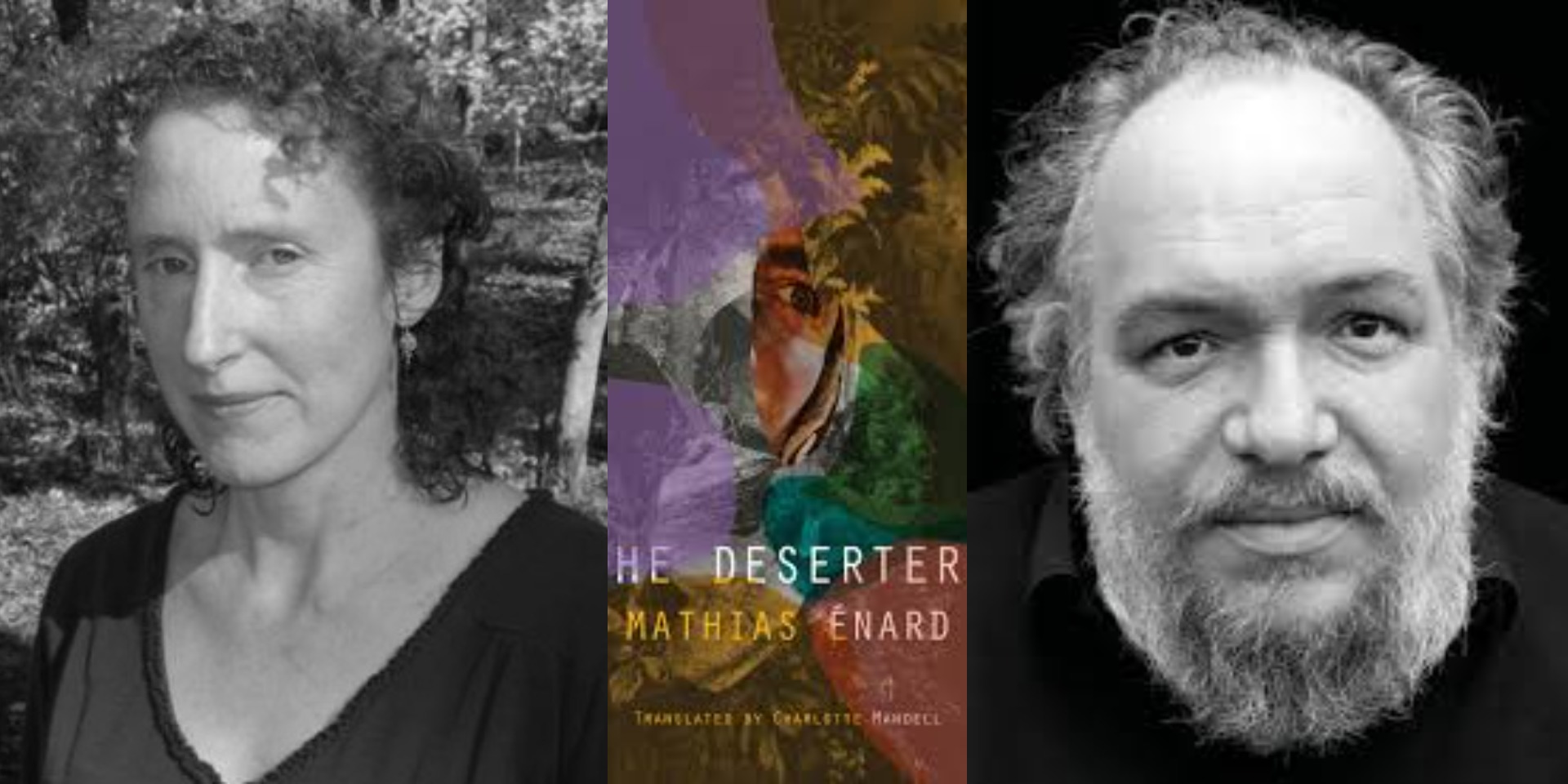
The collaboration continues with The Deserters (published by Fitzcarraldo Editions), a profound exploration of conflict that has recently been longlisted for the 2026 International Booker Prize. In this work, Mandell once again navigates Énard’s signature style—where the boundary between the internal mind and the external world is blurred through continuous, rhythmic prose.
The Philosophy of Translation: Rescuing the "Complexity of Enchantments"
For Mandell, translation is not a mechanical substitution of words but a philosophical engagement with the author's consciousness. She has spent much of her career translating "difficult" thinkers like Maurice Blanchot, whose work demands a deep sensitivity to ambiguity and the "sea of shadows" that exists between languages.
She describes the sensation of reading and translating as being like a "drop of water condensed on the window," a temporary form that will eventually join other molecules and other bodies. This humility before the text allows her to inhabit the author's voice so fully that her presence becomes invisible, leaving the reader with a direct experience of the original's power.
Accolades and Recognition
The excellence of Mandell's work has been recognized by both the American and French literary establishments. Her honors include:
Being named a Chevalier in the Order of Arts and Letters by the French government.
Receiving the Thornton Wilder Translation Prize from the American Academy of Arts and Letters.
These awards serve as a testament to her role as a cultural diplomat, one who ensures that the nuances of French philosophy and fiction are not lost in transit across the Atlantic.

Lin King on 'Taiwanese Travelogue'.